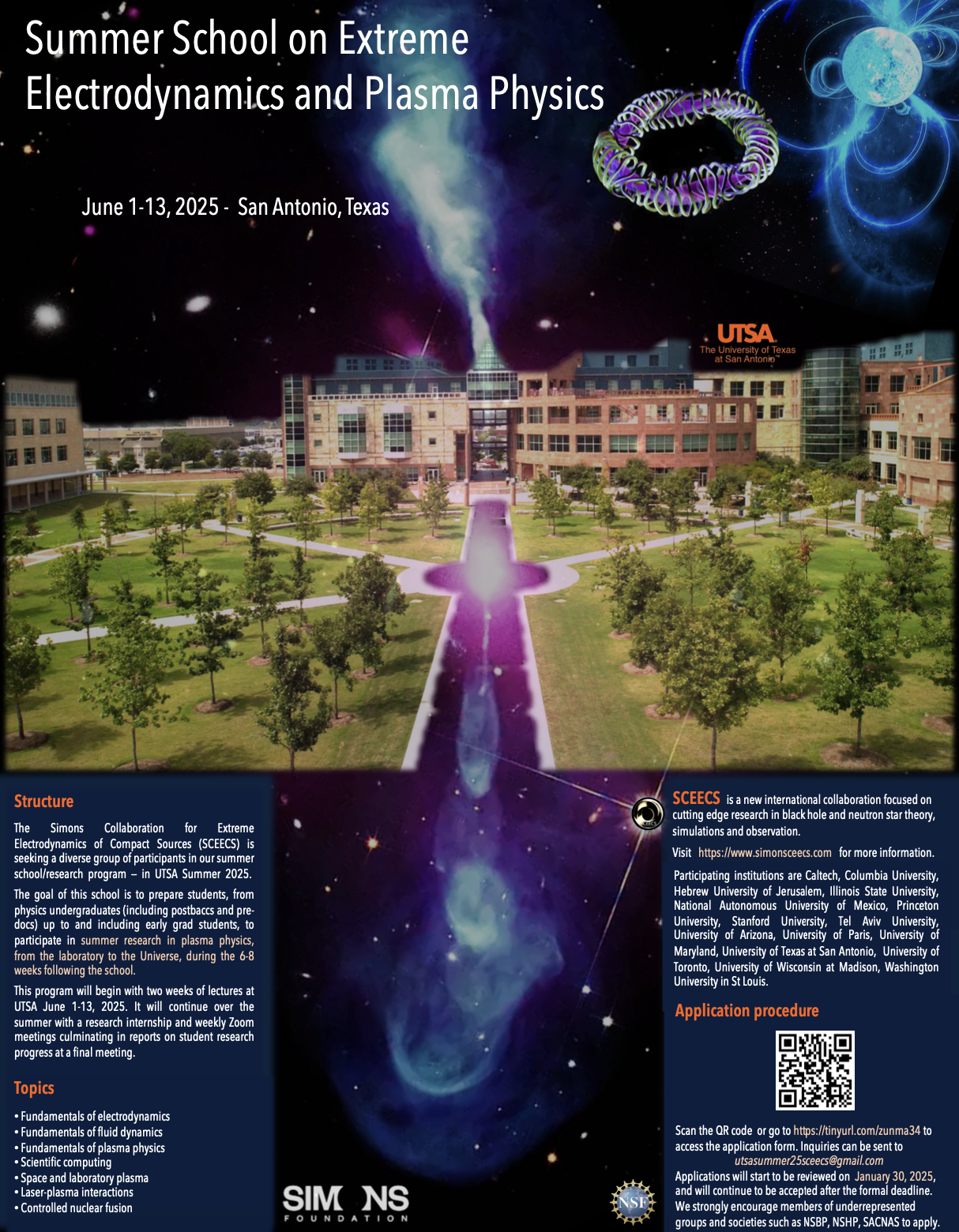
A unique educational and research opportunity to attend survey a course on the fundamentals of electrodynamics with applications to the extreme environments of neutron stars and black holes followed by an intensive course on modern plasma physics culminating in a research internship for select applicants. During the first two weeks of June 2025, this program will bring advanced undergraduate and early graduate students from a broad range of backgrounds together with world-class physicists and astronomers from SCEECS to San Antonio’s premier R1 institution UTSA. Select applicants will continue onto research internships at SCEECS institutions throughout the summer (see SCEECS Research Scholars (SRS)).
Apply by January 30, 2025 using the SCEECS 2025 Summer School Application Form
Confer https://www.simonsceecs.com/summer-school-2025 for details.
Schedule:
Extreme Electrodynamics June 2-6, 2025
- Mathematical Methods
- Introduction to Scientific Computing
- Basic UNIX and Python
- High Performance Computing
- Applications of Coding
- Introduction to
- Classical Mechanics/Lagrangian & Hamiltonian Mechanics
- Statistical Physics/Kinetic Theory
- Electromagnetism
- Introduction
- Radiative processes – dipole radiation
- Introduction to Relativity
- Astronomy
- Neutron Stars
- Black Holes
- Fluid Mechanics
- Hydro and MHD equations, waves
- Hydro Instabilities
Plasma Physics June 9-13, 2025
- Introduction to plasmas
- Non-extreme astrophysical plasmas
- Extreme astrophysical plasmas
- Solar wind + Earth magnetosphere
- More on fluids
- MHD instabilities
- Shocks and Diffusive Shock Acceleration
- Motion of charged particles in EM fields
- Turbulence
- MHD turbulence
- Kinetic turbulence
- Magnetic reconnection
- Relativistic magnetospheres and flows/jets
- Numerical methods
- Laser-plasma interactions
- Fusion plasmas
Lecturers:
Richard Anantua (UTSA/Rice),
Roger Blandford (Stanford University),
Will Fox (Princeton University, PPPL),
Noemie Globus (IA-UNAM/Stanford University),
Sam Gralla (University of Arizona),
Hayk Hakobyan (Columbia University/PPPL),
Philipp Kempski (Princeton University),
Kris Klein (University of Arizona)
Matt Kunz (Princeton University),
Yuri Levin (Columbia University),
Amir Levinson (Tel Aviv University),
Alexander Philippov (University of Maryland),
Jason TenBarge (Princeton University, PPPL),
Adelle Wright (University of Wisconsin-Madison),
Yajie Yuan (Washington University in St. Louis),
Vladimir Zhdankin (University of Wisconsin-Madison)


Student Participants
- Daniel Almonte (SUNY Stony Brook)
- Aneesh Anandanatarajan (University of Maryland)
- Claire Campbell (Illinois State University)
- Zachary Ellis ( UT Austin)
- John Groger (Washington University at St. Louis)
- William Groger (Columbia University )
- Dongxing He ( University of Maryland)
- Kai Jaffarove (University of California, Berkeley)
- Dashon Jones (Rice)
- Sierra Larson (University of Maryland)
- Angelo Lomeli (University of Texas at San Antonio)
- Caitlyn Nojiri (University of California at Santa Cruz)
- Nathaniel Lujan (University of Texas at San Antonio)
- Lazar Paroski (Queen’s University)
- Colton Peterson (University of Washington)
- Ny Avo Rakotondrainibe (Aix-Marseilles University)
- Roberto Serrano (Laguardia Community College)
- Ethan Stace (University of Florida)
- Tegan Thomas (Washington University at St. Louis )
- Hayley West (University of Texas at San Antonio)
- Aaron Weymouth (University of Texas at San Antonio)
SCEECS Research Scholars (SRS)
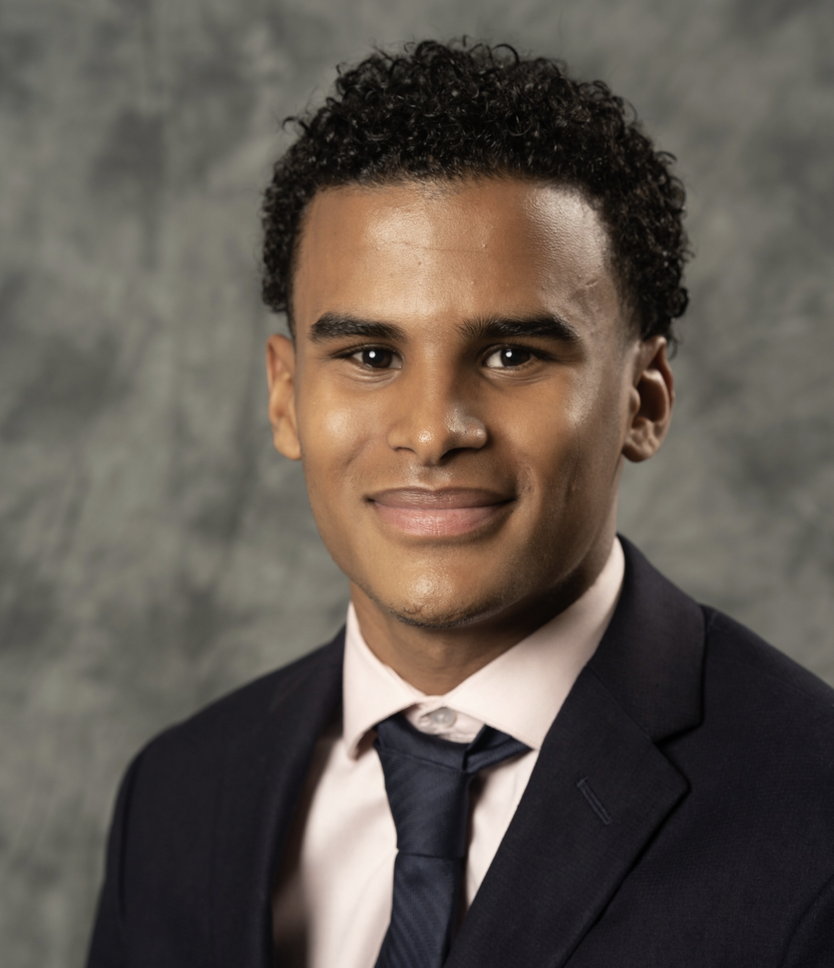
(Stony Brook)
(Mentors: Roger Blandford & Noemie Globus @Stanford)
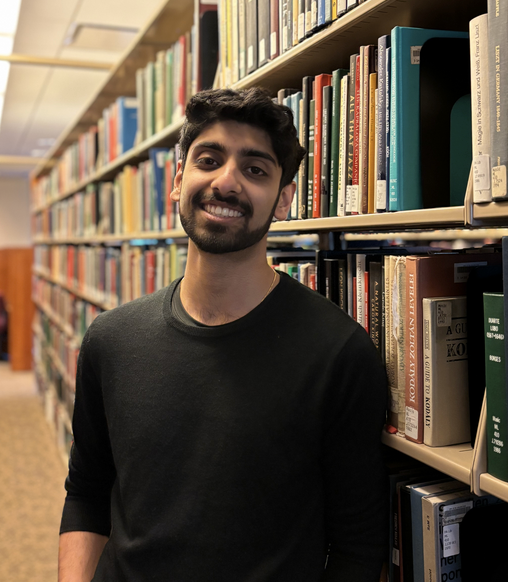
(Mentor: Rostom Mbarek & Sasha Phillipov @UMD)

(UC Santa Cruz)
(Mentors: Roger Blandford & Noemie Globus @Stanford)

(Mentor: Omar French @CU Boulder)
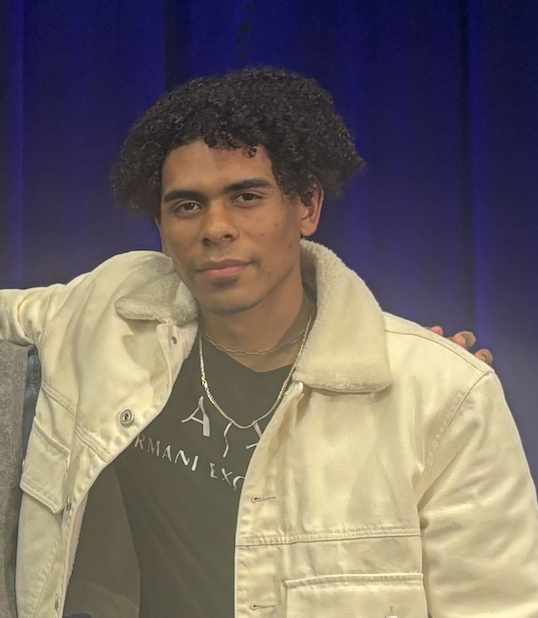
(Mentors: Richard Anantua & Razieh Emami @Harvard)

(Mentor: Yajie Yuan @WashU St. Louis)

(Mentors: Richard Anantua, Genya Gorbunov, Lia Hankla & Sasha Philippov @UMD)
SCEECS Research Scholars 2025 Projects
July 30, 2025 Symposium (Tegan Thomas, Caitlyn Nojiri and Dashon Jones)
Aug 6, 2025 Symposium (Daniel Almonte, Aneesh Anandanatarajan, Colton Peterson and Hayley West)
Daniel Almonte (Mentors: Noemie Globus and Roger Blandford)
Simulating Muon-Induced DNA Damage in Geant4-DNA
The origin of homochirality – the specific handedness of biomolecules – remains a central question in the study of life’s origins. Amongst the abundance of proposed theories, many propose that nature’s chiral choice was random. However, the constant shower of spin-polarized cosmic ray muons that has bombarded Earth’s surface since its formation, is a strong candidate for a causal explanation. This September at the Paul Sherrer Institute, we will irradiate left- and right-chiral RNA by a spin polarized muon beam, in search of a chiral bias in the measured RNA damage. In preparation for this experiment, we use the Geant4-DNA monte carlo toolkit to simulate indirect and direct DNA damage, omitting considerations of spin polarization, to understand how large an effect we would expect from a muon beamline at 65 MeV/c.
Aneesh Anandanatarajan (Mentors: Rostom Mbarek & Sasha Phillipov)
The Role of Gamma-Ray Cascading in Supermassive Black Hole Spectra
Motivated by recent neutrino observations from NGC 1068 that exceed the corresponding gamma-ray flux, we investigate the role of gamma-ray cascading in obscuring high-energy photons in the coronae of supermassive black holes. Magnetic reconnection and turbulence energize protons, leading to gamma-ray production through photomeson interactions. These gamma rays can interact with coronal ultraviolet and X-ray photons, initiating cascades of photons and particles of lower energies. Using a Monte Carlo framework, we numerically model pair production, pair annihilation, and pair propagation in mildly relativistic plasma to quantify the effect of gamma-ray cascading on characteristics of radiation spectra. The results of our study provide insights into the underlying mechanisms responsible for the attenuated gamma-ray spectra and potential pair loading of black hole coronae.
Dashon Jones (Mentors: Razieh Emami and Richard Anantua)
Probing Axions in Relativistic Jets with EHT
The advent of the Event Horizon Telescope has made polarized emission around jet/accretion flow/black hole (JAB) systems directly observable in the strong gravity regime. This regime lies at the intersection of extreme electrodynamic astrophysical processes such as the production of emitting pair plasma and high energy particle phenomenology such as superradiant axion production. We first explore the implications of the inclusion of pairs in a semi-analytic jet model derived from a magnetically arrested disk (MAD) general relativistic magnetohydrodynamic (GRMHD) simulation of the M87 JAB system. Finding trends of enhanced linear and suppressed circular polarization with pair production mediated by Faraday effects, we then introduce various astrophysical scenarios in which electromagnetic fields couple to axions— spin-0 Beyond the Standard Model dark matter candidates arising as a means of addressing the strong CP problem. In the case of 10^-20 eV axion M87*bound states can be produced by superradiant amplification in the ergoregion when the Compton wavelength of the axion field is comparable to the radius of the black hole. We motivate the comparison of axion-induced birefringence on electric vector polarization angles (EVPA) to positron-induced EVPA rotation.
Caitlyn Nojiri (Mentors: Noemie Globus and Roger Blandford)
Modeling the Chirality Experiment
Understanding of the biological mechanism of chirality is an integral piece of the puzzle to unraveling the origins of life. It is hypothesized that the chiral bias seen in life is induced by environmental agents, such as cosmic-ray muons. These high-energy particles are known to play a large role in mutagenesis with the potential to induce a homochiral bias seen in living organisms today. We use Geant4-DNA to simulate the upcoming RNA chirality experiment at the muon beamline at the Paul Scherrer Institute (PSI). Our models approximate the indirect damage caused by free radicals, direct damage from muon interactions, and allow us to improve experimental design. These models in conjunction with the experiment will directly allow us to understand the damage rate of muons and electrons on molecular chirality. Further applications of this simulation can be used to calculate damage to RNA/DNA caused by the surface cosmic-ray flux on Earth and other astrophysical environments.
Colton Peterson (Mentor: Omar French)
Unsupervised extraction of acceleration mechanisms from PIC tracer-particle trajectories
Applications of unsupervised extraction of acceleration mechanisms from tracer-particle trajectories in particle-in-cell simulations.
Tegan Thomas (Mentor: Yajie Yuan)
Charge Starvation of Alfvén waves in Magnetar Magnetospheres
Magnetars are young neutron stars with intense magnetic fields up to 10^{13} -10^{15} G. They frequently undergo quakes at the stellar surface which twist the anchored magnetic field lines, launching Alfvén waves. These waves eventually dissipate and may result in both X-ray and radio emission, however the exact mechanisms for this dissipation aren’t yet fully understood. This project aimed to build off of A. Y. Chen et al. (2022) by investigating Alfvén wave dissipation via charge starvation within a global 2D PIC simulation. So far in the project we have identified a parameter space suitable to achieve charge starvation while still satisfying numerical constraints and we are currently analyzing an initial simulation with these chosen parameters. We additionally have begun exploring the impact that our choice in particle interaction with the neutron star surface has on proper Alfvén wave propagation. Going forward, we will use this knowledge to run a full simulation that meets requirements for numerical stability, has proper wave propagation, and reaches charge starvation early enough before the wave hits the southern hemisphere of the magnetar such that we have sufficient data to investigate the resulting wave dissipation.
Hayley West (Mentors: Lia Hankla, Genya Gorbunov, Sasha Philippov & Richard Anantua)
Collisionless Magnetized Turbulence in Jet/Accretion Flow/ Black Hole Systems
The dynamics of collisionless magnetized turbulence in fast-cooling regimes remain poorly understood, presenting an open question in high-energy astrophysics. While turbulence is known to play a fundamental role in particle acceleration and energy dissipation, the interplay between strong radiative losses and plasma kinetics in such environments remains poorly constrained. This regime can be applicable to physical Jet/Accretion Flow/Black Hole (JAB) systems like Sagittarius A* (Sgr A*) and 3C-279 as well as studying jet brightening regions. Specific sources like Sgr A* exhibit emission signatures suggesting that turbulence, affected by synchrotron cooling, may govern their non-thermal spectra and variability. We investigate these microphysical details with Entity, a coordinate-agnostic particle-in-cell (PIC) code. We conduct a 2D simulation initializing large-scale turbulence into a magnetic field and investigate how small scale dissipation affects energy ranges, particularly the range between eradiation. By incorporating synchrotron cooling into the simulation, we examine how radiative losses modify particle acceleration processes and energy spectra. Beyond local plasma dynamics, this study can bridge the gap between kinetic-scale physics and global accretion models. This methodology of exploring the co-evolution between radiative processes and turbulence can be applied to our global GRMHD investigations into “observing” JAB systems and other high-energy astrophysical sources.